Finish Well. Start Fresh.

by Steve Spence

Let’s be honest—coming to the end of the calendar year feels great. There’s a real sense of accomplishment. We made it. Another year in the books. And yes, it deserves celebration. But if you’re in ministry, you know that feeling doesn’t last long. January comes fast, full of events, planning, and the pressure to hit the ground running. The celebration window is short.
So how do we honor the year we just lived and still walk into a new one without ministry fatigue?
For me, it starts with celebrating the right wins. Not the stats. Not the attendance spikes. Not the big nights that look great in photos but don’t always reflect real spiritual formation. I celebrate the stories.
I think of the student who fell in love with Jesus for the first time. The one who started reading their Bible on their own because the Spirit stirred something new in them. The one who let go of a destructive habit and took a step toward Christ. Those aren’t numbers—they’re eternal victories.
I think of the adult leader who stepped up in a way I didn’t expect. The one who took ownership of their small group, followed up with students, discipled faithfully, prayed consistently, and grew in their own walk. That’s the kind of win worth carrying into a new year.
And then there’s baptism—the clearest picture of life change we get as youth pastors. When I look back and remember each face, each story, each moment of bold obedience, I’m reminded that God is at work even when I’m tired or discouraged.
I’ve learned to journal these stories before the year closes. Writing them down opens my heart to gratitude and recalibrates my perspective. It’s too easy to focus on what didn’t happen, what fell short, or what still needs fixing. Gratitude reminds me that God has been faithful, and I’m just a participant in His work.
Another practice that’s helped me finish well is taking time to Sabbath. Not a day off filled with errands, but intentional rest. A couple of days away from the pace and pressure of ministry. Doing something that brings life back into my soul. Spending unhurried time with my family or my spouse. Making space to breathe again.
During these days, I slow down in my quiet time. I listen more. I journal what I sense the Holy Spirit is speaking into the next season—what’s true about God, what’s true about me, and what’s true about the ministry He’s entrusted to me. I always walk away more grounded than when I started.
Finishing the year strong isn’t about squeezing out one more task or sprinting toward January. It’s about reflection, gratitude, rest, and spiritual clarity. When I honor the year behind me, I’m healthier walking into the year in front of me.
If you’re reading this and feeling the weight of the year—or the pressure of what’s coming next—I’d love to walk with you. You can connect with me at freshcalling.org, and if you want to take a next step, your first coaching session is free. Ministry doesn’t have to feel isolating. Let’s step into the new year grounded, encouraged, and ready.
Would you help me out by sharing this blog post with someone else? I appreciate your willingness to help spread the word about Fresh Calling. It means a lot when you “like, share and subscribe.”
Merry Christmas and Happy New Year!
Have a Plan

by Steve Spence
This is part three in our series dealing with the devotional life of the youth pastor.
There’s something I’ve learned over the years about my walk with Jesus: if I don’t plan it, it probably won’t happen. I don’t drift into spiritual health. I don’t accidentally fall into the Word. And I’m guessing you don’t either. Ministry is loud. Student ministry is really loud. If we aren’t intentional about carving out a moment—just one planned, protected moment—to be in God’s Word every single day, that moment will get swallowed up by the chaos around us.
So here’s point number one: Have a plan each day.
I’ve talked to so many youth pastors who love Jesus dearly but feel spiritually dry, scattered, or inconsistent. And when we peel back the layers, most of the time there’s simply no daily plan. Not because they don’t care. Not because they’re lazy. But because they’re getting jumped by the day instead of stepping into the day with direction.
For me, planning my daily time with the Lord is as non-negotiable as brushing my teeth. I know that sounds simple, but it’s been a game changer. I look at my day and decide when I’m meeting with Him—before the kids wake up, before emails, before the “urgent” squeezes out the “important.” And once that time is set, I protect it like it’s oxygen. Because honestly, it is.
But having a planned time isn’t enough. You also need a planned approach.
A lot of youth pastors ask me, “Steve, what do you actually do during your quiet time?” And my answer always starts here: Have a plan for what you’re reading. Not a random verse of the day. Not flipping to the same encouraging passages over and over. Not just camping out in the New Testament because it feels easier. No—have a plan that gets you into the whole counsel of God.
Every year—yes, every single year—I read through the entire Bible. I’m not saying that to give myself a gold star. I’m saying it because it’s changed me. It’s anchored me. It’s strengthened me in ways I didn’t even know I needed. I switch between the Chronological Bible reading plan and the One Year Bible reading plan. Both are fantastic. Both keep me rooted in Scripture beyond just the parts I naturally gravitate toward.
A reading plan gives you structure. It keeps you moving. It helps you see the story of God unfold—not just a verse here or there, but the full narrative of His faithfulness from Genesis to Revelation. And when you build your devotional life around the full story of Scripture, your soul starts receiving the nutrients it’s been craving.
And let me be clear about something that trips up a lot of youth pastors: your devotional time is not your sermon prep time.
You need both.
They aren’t the same.
Sermon prep is ministry work. Your devotional time is ministry life. One feeds others. The other feeds you. Don’t confuse the two or you’ll dry up faster than you think. Your daily devotional time is simply your planned connection with God. Not for content. Not for students. Not for Sunday. For you and Him.
So here’s my encouragement: if you want to grow in your own walk, if you want to be spiritually steady, if you want to lead students from a place of overflow rather than exhaustion—make a plan. A plan for your day, and a plan for the Word.
Because you can’t be spiritually healthy accidentally.
You’re too called for that.
Your students need more than a spiritually malnourished leader.
And God is ready to meet you—every day—if you’ll plan to meet with Him.
Let’s be youth pastors who don’t just talk about devotion…
Let’s plan for it.
And then live it.
If you’re a youth pastor who’s struggling to build consistency in your devotional life—or you just need someone in your corner cheering you on—I’d love to walk with you. Through Fresh Calling, I help youth pastors develop rhythms, clarity, and confidence in their daily walk with Jesus and their ministry leadership.
You don’t have to figure this out alone.
If you want to talk, process, or take the next step, reach out through FreshCalling.org/coaching. I’d be honored to connect.
It’s Not Meant to Be Scary!!

by Steve Spence
For some youth pastors, fear slips in quietly. It’s not the kind that jumps out and startles you — it’s the kind that lingers in your thoughts after a long night of ministry. You wonder if what you’re doing really matters, if the students are growing, or if you’re still the right person for this role.
Ministry can stir up those kinds of questions. It’s full of change, emotion, and expectations. But fear was never meant to be part of the job. God called you into this work, and that calling hasn’t faded. Philippians 1:6 reminds us, “He who began a good work in you will carry it on to completion until the day of Christ Jesus.” That truth holds steady when your confidence doesn’t.
Most of the fear we carry comes from forgetting who’s responsible for the results. God didn’t ask us to prove ourselves — He asked us to stay faithful. When fear starts shaping how you think or lead, it helps to slow down and remember that your confidence doesn’t come from how the ministry looks. It comes from the God who called you to it.
If you’ve been feeling uncertain or anxious about where you stand, here are a few small but steady ways to find your footing again:
- Talk honestly with God about your fears. Don’t rush through it. Tell Him what feels heavy or unclear. Naming your fears before Him helps them lose their grip.
- Read something that reminds you why you love ministry. Whether it’s a passage of Scripture, a book, or an old journal entry, give yourself a reminder of what God has already done.
- Spend time with people who refresh your faith. Not everyone understands the weight of ministry. A trusted friend, mentor, or another pastor can help you see things more clearly.
- Step away from comparison. Measuring yourself against other ministries only fuels insecurity. Focus on the students and leaders God has placed in front of you.
- Find one moment of joy each week. A conversation with a student, a laugh with your volunteers, or an answered prayer — let those moments remind you that God is at work.
- Rest without guilt. Taking care of your soul isn’t a sign of weakness; it’s a way of staying healthy for the long haul.
Fear may still come around from time to time, but it doesn’t have to shape how you lead. The same God who called you will finish what He started — in your students and in you.
You don’t need to have it all figured out. You just need to stay close to the One who does.
If you’ve been walking through a season of uncertainty and would like to process what God’s doing in your ministry, click here to set up a one-on-one coaching session. You don’t have to lead through fear alone.
Recapturing Your Joy

by Steve Spence
Somewhere between planning sermons, counseling students, organizing events, and keeping up with parents’ texts, many youth pastors quietly lose something essential—joy. You didn’t mean to. You still love Jesus, and you still care deeply for students, but ministry has slowly become more about managing than ministering. If that’s where you are today, you’re not alone. But the good news is—you can get your joy back.
Joy isn’t something we manufacture; it’s something we protect and refresh. Paul told the Philippians, “Rejoice in the Lord always. I will say it again: Rejoice!” (Philippians 4:4, CSB). That wasn’t just a suggestion—it was a lifeline. Ministry joy flows from the presence of Jesus, but it’s often rekindled through small, intentional choices that renew your heart and perspective.
Here are a few ways to recapture your joy in ministry this month:
Rekindle the Spark
- Recruit new leaders. Fresh faces bring new energy. Invite someone younger or different than you to join the team. Their excitement might just reignite yours.
- Change up your midweek format. Do something unexpected. Cancel your usual program and plan a night of games, worship, or student testimonies. Sometimes joy returns when you stop trying so hard to “get it right.”
- Delegate a responsibility. Give away a task that drains you and let a volunteer own it. Empowering others lightens your load and multiplies your impact.
Refocus Your Heart
- Spend your day off with your spouse or family. Ministry is not meant to steal your joy at home. Schedule something fun, unplug completely, and laugh a lot.
- Go on a prayer walk. Not for your next message—just to talk with Jesus. Ask Him to restore the “why” behind what you do.
- Read a Gospel slowly. Get back to the simplicity of Jesus’ presence and mission. Let His words renew your purpose.
Refresh Your Perspective
- Grab coffee with another youth pastor. Swap stories, share struggles, and pray for each other. Sometimes the most healing thing is realizing you’re not the only one who feels worn out.
- Attend a conference or retreat. Don’t just go for content—go for connection. Worship with others who understand the weight of what you carry. Let God speak to you before you speak to students again.
- Celebrate small wins. A student reading their Bible. A volunteer showing up early. A parent saying thanks. Write them down and thank God for the evidence of His work.
I do most of these pretty often. They are all life-giving, ministry-sustaining activities. Joy doesn’t always return overnight, but it grows when you give God room to restore it. Don’t settle for surviving ministry—step into enjoying it again. You were never meant to fake joy to serve Jesus; you were meant to find joy in serving Him.
One more thing: if you’re feeling dry, don’t go it alone. Click to set up a 1-on-1 coaching session through Fresh Calling—let’s talk about how to help you lead with joy again.
The Pit of Performance Based Student Ministry
by Steve Spence
I’ve fallen into the pit of performance-based youth ministry more times than I’d like to admit. You know the one—the deep hole where the health of your ministry feels tied to how well you preached, how many students showed up, or how loud the laughter was at the event you spent weeks planning. It’s that silent belief that if I perform well, the ministry will flourish. And if I don’t, everything falls apart.
It’s a dangerous pit—one that smells a lot like success but is filled with pride.
I can remember seasons where I gauged the effectiveness of our student ministry by the energy in the room. If students were engaged, laughing, and responding, I walked away feeling confident. But when the night felt flat, I’d drive home replaying every line of my talk, wondering where I’d lost them. My worth as a pastor was being measured by applause, not obedience. My joy was tethered to performance, not presence.
Here’s the truth I had to learn the hard way: when the spotlight is on me, it can’t be on Jesus.
Dr. Richard Ross, in his powerful book Student Ministry and the Supremacy of Christ, reminds us that when students aim their lives toward Jesus, He becomes the star of the show. That one statement wrecked me. I realized I’d subtly made ministry about what I could do for Jesus instead of who I was becoming in Jesus. I was performing for Him rather than pointing to Him.
Performance-based ministry starts small. It begins with a sincere desire to do things well—because excellence matters. But it slowly morphs into an obsession with outcomes. We start checking attendance instead of checking hearts. We start crafting moments that “wow” instead of cultivating moments that “worship.” And before long, we’re exhausted, because keeping the spotlight on ourselves takes endless energy.
The worst part? When we perform as the lead discipler, we unintentionally prop ourselves up as the only one capable of discipling students. That’s not ministry—that’s dependency. We teach students to look to us for spiritual growth instead of Jesus. And when we do that, we stunt the very discipleship we’re trying to foster.
The seed of this mentality is pride. It whispers, “If you don’t do it, it won’t get done right.” It tells us the ministry needs our voice, our charisma, our leadership to thrive. Pride hides itself under the mask of “excellence” but feeds on insecurity.
The reality is, performance-based ministry can look really successful from the outside. It can even draw crowds. But crowds aren’t the same as disciples. Jesus had both, but He never confused the two. The crowd was loud, but the disciples were loyal. The crowd wanted a show; the disciples wanted a Savior.
When we make ministry about our performance, we start to crave the crowd more than the presence of Christ.
The shift for me came when I stopped asking, “How did I do?” and started asking, “Did I point them to Jesus?” It’s a simple question that re-centers everything. Because at the end of the day, the goal of youth ministry isn’t to make people remember us—it’s to make them remember Him.
I’ve learned that freedom in ministry comes when you stop performing and start abiding. Jesus said, “I am the vine; you are the branches. The one who remains in me and I in him produces much fruit, because you can do nothing without me”(John 15:5, CSB). Abiding doesn’t require performance—it requires surrender.
So if you’re reading this and you feel that pressure to perform—take a deep breath. Step out of the spotlight. The ministry doesn’t rise and fall on your shoulders. It rests securely in the hands of Jesus.
You are not the main event. He is.
Maybe today is a good day to repent of pride and step back into humility. To remind yourself that your calling is not to perform but to point. To teach your students, volunteers, and parents not to follow you, but to follow Him.
When Jesus is the focus, freedom follows. The burden lifts. The joy returns. And the ministry begins to look less like a stage and more like a movement.
Don’t let pride build a pit you have to climb out of later. Step into the light—the kind that shines on Jesus alone.
That’s where the real fruit grows.
If this message hit home and you’re wrestling with what it means to lead from a place of authenticity and surrender, I’d love to walk alongside you. Click the link below to schedule a one-on-one coaching session through Fresh Calling. Together, we’ll rediscover the joy of ministry that points fully to Jesus—and lead from a place of freedom, not performance.
A Seasoned Response: How has youth ministry changed over the past 30 years?
This blog post is real and raw. Nothing generated or fake… my honest thoughts about the state of student ministry and the role of the youth pastor. It’s the beginning of series of blog posts answering questions about student ministry from a seasoned youth pastor perspective.
I’m often asked: “How has student ministry changed over the 30 years you’ve been a part of it?” My seasoned response? A lot.
When I started out, ministry to teenagers was simpler in many ways. The biggest issues I encountered were breakups, friendship drama, or the occasional bad decision that made its way into the spotlight. Those things were important, of course, and I spent many late nights on the phone or at the local diner listening to students sort through life. But looking back, the weight that teenagers carried was lighter than what I see today.
Now, the issues pressing on students are heavier, and they come at them from all directions. I regularly sit with students battling anxiety or depression. Some are questioning their identity or trying to process a world that feels unstable. Others are drowning in loneliness while living in constant connection online. The struggles are more intense, the wounds are deeper, and the questions are harder. Fun and games are still part of ministry—and they should be—but if that’s all we offer, we are leaving students without real help for the real battles they face.
Another shift I’ve seen is in parents. Thirty years ago, most parents—whether or not they were deeply spiritual—were at least actively engaged in their children’s lives. They wanted to know who their kids were with, what they were doing, and how they were growing. These days, I find many parents are distracted, tired, or caught up in the same digital fog as their children. Smartphones and social media have stolen time, focus, and presence from the home. And yet, Scripture is clear: “Repeat [these words] to your children. Talk about them when you sit in your house and when you walk along the road, when you lie down and when you get up” (Deuteronomy 6:7, CSB). The role of teaching and modeling faith belongs first to parents, but when they disengage, the responsibility often shifts to the church in ways it was never meant to.
But perhaps the biggest change I’ve noticed is in the way churches themselves view student ministry. When I began, the expectation was that a youth pastor was, first and foremost, a shepherd. My job wasn’t just to preach or to plan; it was to know students personally, walk with them, and invest in their faith. Somewhere along the way, many churches began to prize charisma over consistency. They looked for gifted communicators who could draw a crowd, leaders who could create momentum, and personalities who could keep students entertained. Those aren’t bad qualities, but if they replace the heart of a shepherd, something essential is lost.
Jesus doesn’t describe the good shepherd as flashy. He says, “The good shepherd lays down his life for the sheep” (John 10:11, CSB). That is not a description of performance, but of presence. It’s about sacrifice, patience, and faithfulness. And Peter echoes this when he exhorts leaders: “Shepherd God’s flock among you… not lording it over those entrusted to you, but being examples to the flock” (1 Peter 5:2–3, CSB). Shepherding is relational. It’s not always noticed by the crowd, but it’s always noticed by the sheep.
I remember one student early in my ministry who constantly tested my patience. He skipped small group, acted up during teaching, and pushed boundaries every chance he got. Honestly, there were times I wanted to give up on him. But the more time I spent with him outside the church walls—at his games, grabbing a burger, or just talking after school—the more I realized that what he needed wasn’t another sermon. He needed someone to stay. Years later, he told me, “I don’t remember much of what you taught, but I remember you were there.” That is shepherding. And that is what’s in danger of being lost.
A lot has changed in student ministry over the past thirty years. The issues are bigger, the culture is louder, and the distractions are everywhere. But the calling hasn’t changed. Students still need shepherds who will walk with them through the valleys and point them to Jesus. They don’t need perfection; they need presence. They don’t need another program; they need people who love them enough to lay down their lives in service.
My seasoned response is this: student ministry looks different than it used to, but the call of the shepherd is as urgent as ever. My prayer is that God would raise up leaders who care more about faithfulness than flash, more about discipleship than numbers, and more about being with students than being noticed by the crowd. Because in the end, what will make the lasting difference is not how impressive we look but how faithfully we shepherd the flock entrusted to us.
Want to hear the answer to another question about student ministry from a seasoned youth pastor? Comment below and I’ll do my best to answer it in another blog post.
A Day in the Life of a Youth Pastor

Do you have students come up to you occasionally and ask… “What do you do?’ Oh the mystery of the Monday through Friday pastor. I guess they think we don’t do anything but sit around and wait for them to come back to church. You and I both know there are a lot of things we do though out the week. Planning. Meeting with Pastor. Guest follow up. Room clean up and set up. And so much more.
So in a response to some of the preconceived ideas many of them have, I made a instragram reel of a typical day of a youth pastor. It was a fun exercise and enlightening to those who watched it.
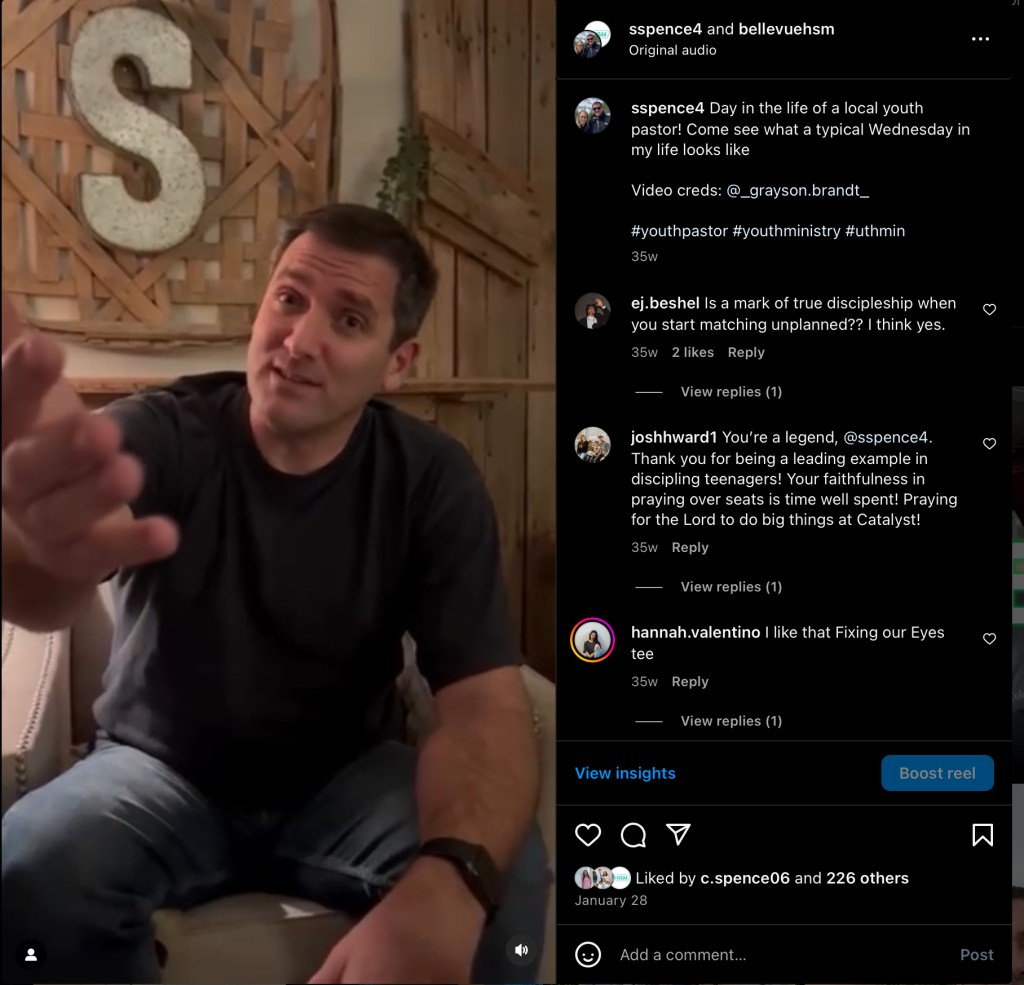
Here is the fun moment… I shot the video, but one of our students edited it and formatted it for me.
What do you do during the week? What does your follow up and preparation look like? Are you spending time with your wife and kids too? Leave a comment or book a coaching session with Steve to take a deep dive in the behind the scenes look at what a youth pastor does any given day.
Husband, Dad, Youth Pastor, Writer


 Fresh Calling: Ministry Coaching and Consulting
Recent Comments